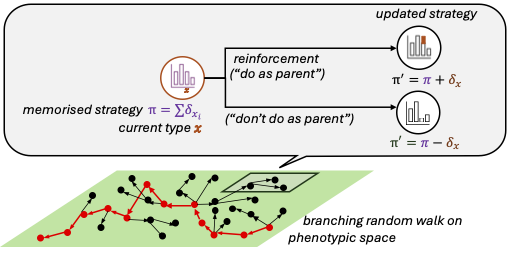
Reinforced populations
Memory, phenotypic plasticity and selection in growing populations.
Project detailsI am a probabilist applied mathematician working on stochastic models across different scales of living systems, from nano-scale biosensors to evolving populations. Since April 2024, I have been a postdoctoral researcher in Tetsuya Kobayashi’s team at the Institute of Industrial Science, The University of Tokyo.
I completed my Ph.D. in applied mathematics at CMAP, École polytechnique, in February 2024, under the supervision of Sylvie Méléard and Meriem El Karoui, within the PEIPS group and Inria project-team MERGE.
I am particularly interested in long-time behaviour, fluctuations and selection mechanisms, and in the roles of individual variability and inherited memory in the macroscopic properties of growing populations. My work draws on branching processes, structured population models, spectral methods and more recently, the theory of large deviations.
Memory, phenotypic plasticity and selection in growing populations.
Project details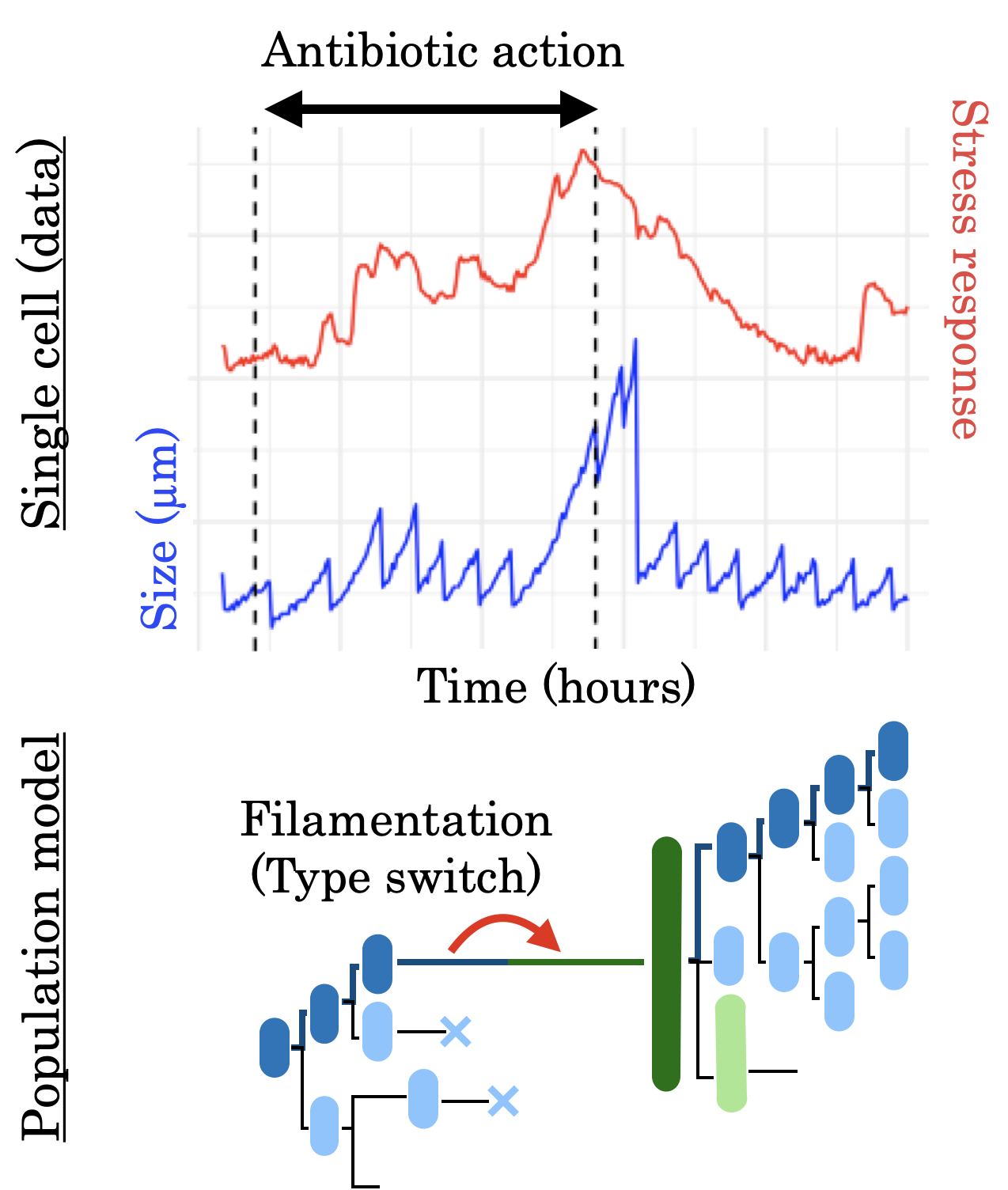
From single-cell growth and division to population heterogeneity under antibiotics.
Project details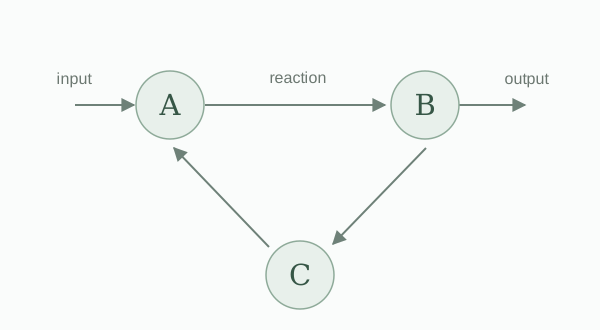
Probability models for chemical reactions in growing biological systems.
Project details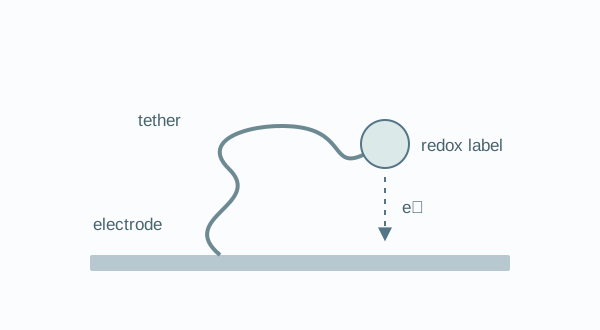
Counting statistics and stochastic modelling of DNA-based electrical measurements.
Project detailsJournal of Mathematical Biology, 93
Abstract Under low concentrations of antibiotics causing DNA damage, Escherichia coli bacteria can trigger stochastically a stress response known as the SOS response. While the expression of this stress response can make individual cells transiently able to overcome antibiotic treatment, it can also delay cell division, thus impacting the whole population’s ability to grow and survive. In order to study the trade-offs that emerge from this phenomenon, we propose a bi-type age-structured population model that captures the phenotypic plasticity observed in the stress response. Individuals can belong to two types: either a fast-dividing but prone to death “vulnerable” type, or a slow-dividing but “tolerant” type. We study the survival probability of the population issued from a single cell as well as the population growth rate in constant and periodic environments. We show that the sensitivity of these two different notions of fitness with respect to the parameters describing the phenotypic plasticity differs between the stochastic approach (survival probability) and the deterministic approach (population growth rate). Moreover, under a more realistic configuration of periodic stress, our results indicate that maximal population growth can only be achieved through fine-tuning simultaneously both the induction of the stress response and the repair efficiency of the damage caused by the antibiotic.
Acta Applicandae Mathematicae, 187