Research
Cell growth under stress
From the dynamics of single cells to the emergence of population heterogeneity.
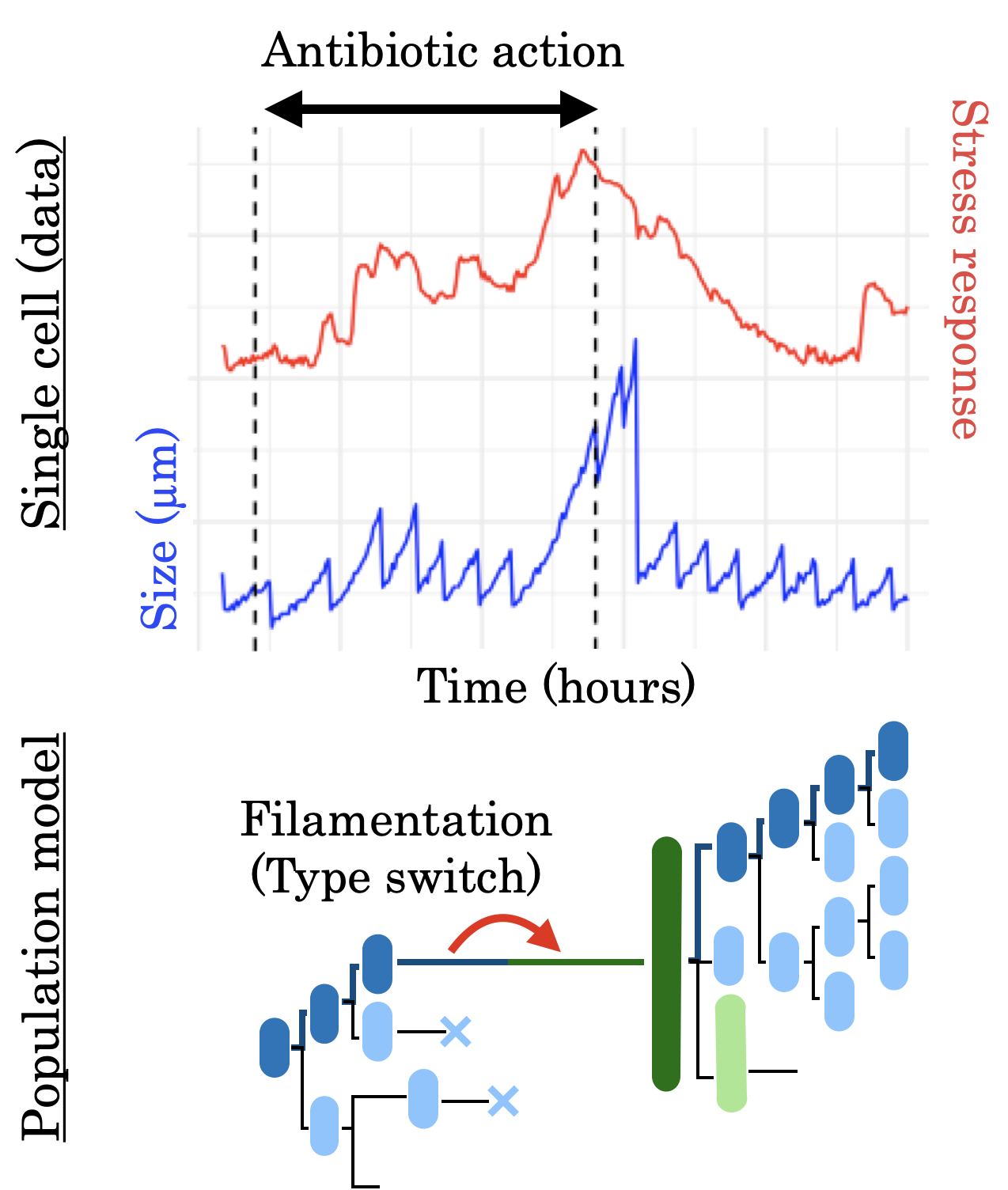
My work on Escherichia coli combines single-cell observations with stochastic models of growth, division and phenotypic switching under antibiotic stress.
DNA-damaging antibiotics can change the growth strategy of bacteria, and cells do not respond uniformly. The nutritional environment also affects these responses. I use structured, measure-valued population models to study how these individual differences shape population growth and heterogeneity.
This work formed the core of my doctoral research, supervised by Sylvie Méléard and Meriem El Karoui at CMAP, École polytechnique.
Related publications
Phenotypic plasticity trade-offs in an age-structured model of bacterial growth under stress
Meriem El Karoui, Ignacio Madrid, Sylvie Méléard
Journal of Mathematical Biology, 93
Abstract
Abstract Under low concentrations of antibiotics causing DNA damage, Escherichia coli bacteria can trigger stochastically a stress response known as the SOS response. While the expression of this stress response can make individual cells transiently able to overcome antibiotic treatment, it can also delay cell division, thus impacting the whole population’s ability to grow and survive. In order to study the trade-offs that emerge from this phenomenon, we propose a bi-type age-structured population model that captures the phenotypic plasticity observed in the stress response. Individuals can belong to two types: either a fast-dividing but prone to death “vulnerable” type, or a slow-dividing but “tolerant” type. We study the survival probability of the population issued from a single cell as well as the population growth rate in constant and periodic environments. We show that the sensitivity of these two different notions of fitness with respect to the parameters describing the phenotypic plasticity differs between the stochastic approach (survival probability) and the deterministic approach (population growth rate). Moreover, under a more realistic configuration of periodic stress, our results indicate that maximal population growth can only be achieved through fine-tuning simultaneously both the induction of the stress response and the repair efficiency of the damage caused by the antibiotic.
Regime switching on the propagation speed of travelling waves of some size-structured Myxobacteria population models
Vincent Calvez, Adil El Abdouni, Maxime Estavoyer, Ignacio Madrid, Julien Olivier, Magali Tournus
ESAIM: Proceedings and Surveys, 77, 195-212
Abstract
The spatial propagation of complex populations can depend on some structuring variables. In particular, recent developments in microscopy have revealed the impact of bacteria heterogeneity on the population motility. Biofilms of Myxococcus xanthus bacteria have been shown to be structured in clusters of various sizes, which remarkably, tend to move faster when they consist of a larger number of bacteria. We propose a minimal reaction-diffusion discrete-size structure model of a population of Myxococcus with two possible cluster sizes: isolated and paired bacteria. Numerical experiments show that this model exhibits travelling waves whose propagation speed depends on the increased motility of clusters, and the exchange rates between isolated bacteria and clusters. Notably, we present evidence of the existence of a characteristic threshold level θ*. on the ratio between cluster motility and isolated bacteria motility, which separates two distinct regimes of propagation speed. When the ratio is less or equal than θ*, the propagation speed of the population is constant with respect to the ratio. However, when the ratio is above θ*, the propagation speed increases. We also consider a generalised model with continuous-size structure, which also shows the same behaviour. We extend the model to include interactions with a resource population, which show qualitative behaviours in agreement to the biological experiments.
Quantitative effects of the stress response to DNA damage in the cell size control of Escherichia coli Preprint
Ignacio Madrid, James Broughton, Sylvie Méléard, Meriem El Karoui
Abstract
Model of Cellular Growth under Stress : Emergence of Heterogeneity and Impact of the Environment Doctoral thesis
Ignacio Madrid Canales
Abstract
Modèle de croissance cellulaire sous l’action d’un stress : Émergence d’hétérogénéité et impact de l’environnement Cette thèse porte sur l'analyse statistique et mathématique de la croissance cellulaire à l'échelle individuelle sous l'effet d'un stress. À partir de l'analyse des données recueillies par Sebastián Jaramillo et James Broughton sous la direction de Meriem El Karoui, nous avons construit différents modèles permettant une compréhension à différents niveaux de l'impact que la réponse hétérogène au stress génotoxique (réponse SOS) a sur la croissance d'une population de bactéries Escherichia coli. Pour modéliser la dynamique de ces populations on utilise des processus stochastiques à valeurs mesures.Nous construisons tout d'abord on construit un modèle stochastique basé sur le modèle "adder" de contrôle de la taille, étendu pour incorporer la dynamique de la réponse SOS et son effet sur la division cellulaire. Le cadre choisi est paramétrique et le modèle est ajusté par maximum de vraisemblance aux données de lignées individuelles obtenues en mother machine. Cela nous permet de comparer quantitativement les paramètres inférés dans différents environnements.Nous nous intéressons ensuite aux propriétés ergodiques d'un modèle plus général que "adder", répondant à des questions ouvertes sur son comportement en temps long. On considère un flot déterministe général et un noyau de fragmentation non nécessairement auto-similaire. Nous montrons l'existence des éléments propres. Ensuite, une dollar_h_dollar-transformée de Doob avec la fonction propre nous ramène à l'étude d'un processus conservatif. Enfin, en montrant une propriété de petite set pour les compacts de l'espace d'états, nous obtenons alors la convergence exponentielle du modèle.Finalement, nous considérons un modèle bitype structuré en âge modélisant la plasticité phénotypique observée dans la réponse au stress. Nous étudions la probabilité de survie et le taux de croissance de la population en environnement constant et périodique. Nous mettons en lumière un trade-off pour avoir la survie de la population, ainsi qu'une sensibilité par rapport aux paramètres du modèle qui n'est pas la même pour la probabilité de survie et pour le taux de croissance.Nous concluons avec une section indépendante, initiée durant le CEMRACS 2022. Nous étudions numériquement la propagation spatiale des populations structurés en taille modélisant le mouvement collectif de clusters de Myxobactéries à travers de systèmes d'équations de réaction-diffusion.
Exponential Ergodicity of a Degenerate Age-Size Piecewise Deterministic Process
Ignacio Madrid
Acta Applicandae Mathematicae, 187